Providing comfort, acknowledgment, and lasting memories for families experiencing unimaginable loss.
Love From Penny & Lyla provides care and keepsake packages to Canberra area hospitals and clinics, for parents who have experienced the loss of their precious baby, at any stage.
We partner with Canberra hospitals and health care staff to ensure families whose baby has died, at any stage of pregnancy through to early infancy, receive practical support, comfort, and opportunities to create precious memories that will last a lifetime.
We help bereaved parents feel seen, supported, and remembered during the most heartbreaking moments of their lives.

Our Impact
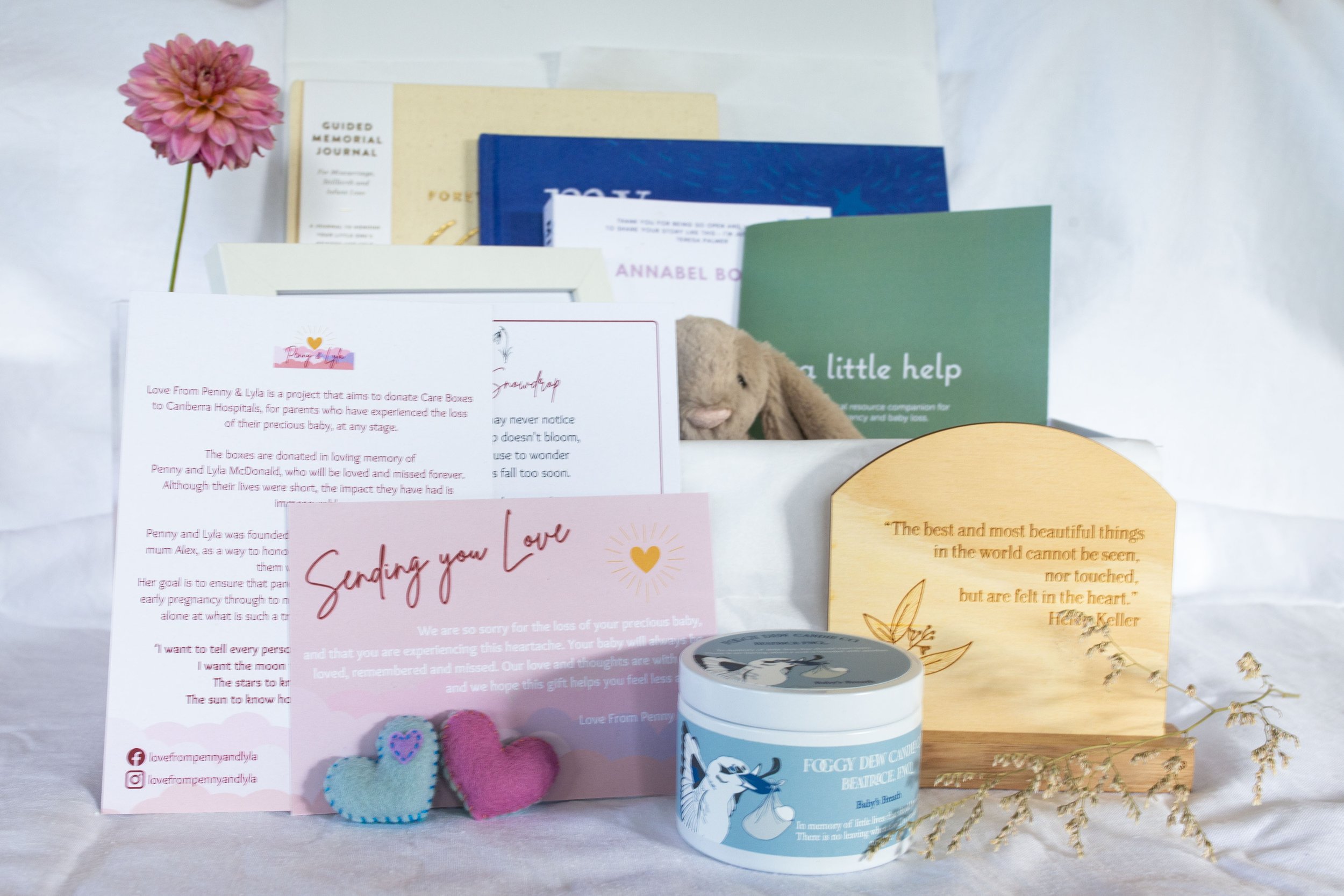
Creating Memories
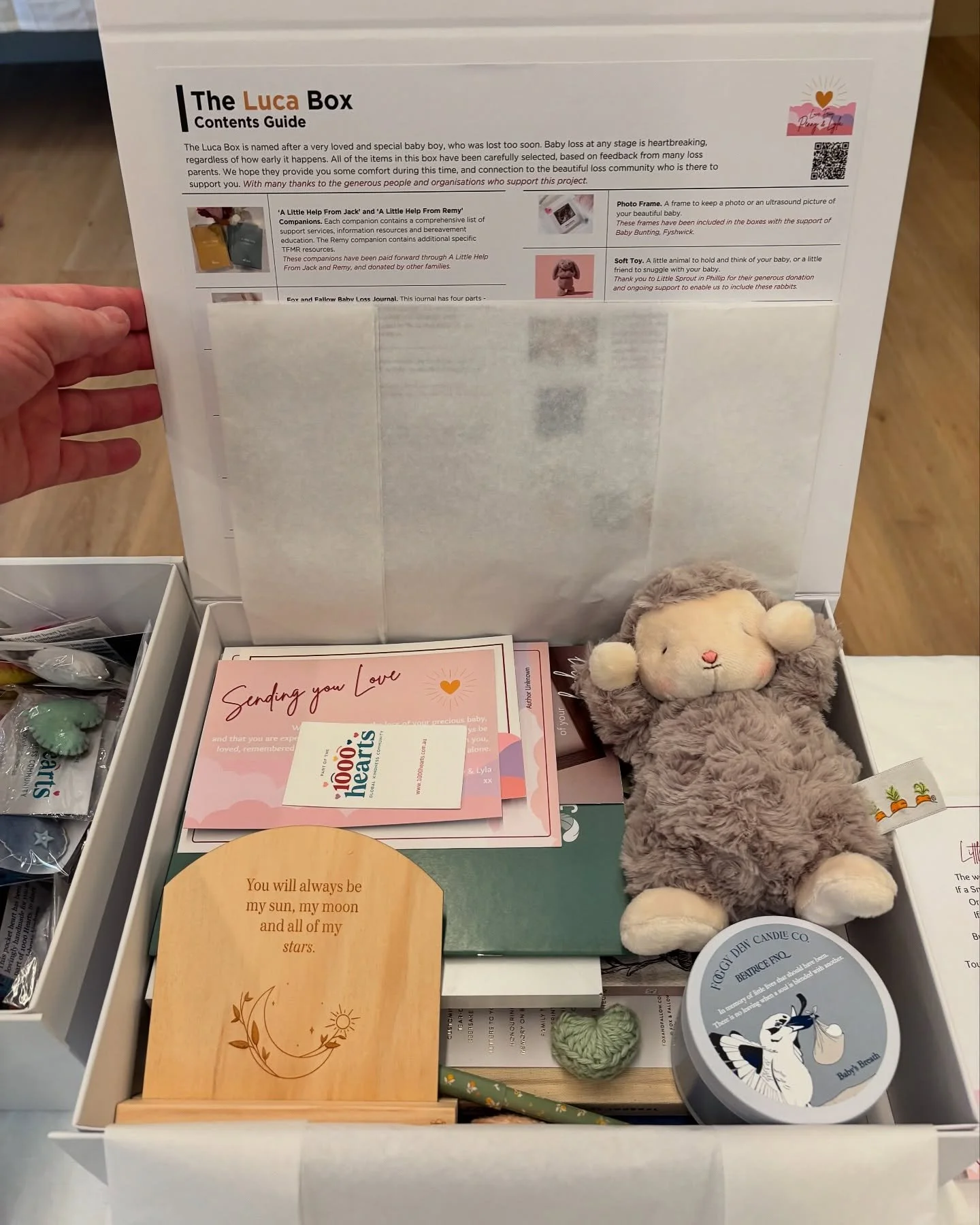
We create opportunities for memory-making, connection, and remembrance during a family's darkest moments. Our carefully created care boxes and bags offer keepsakes and ways to create and capture memories.

Community and Connection
Creating connection through community, to ensure no one walks this path alone. We offer safe spaces to share, grieve and connect. Our compassionate community supports parents - whether loss was recent or long ago.
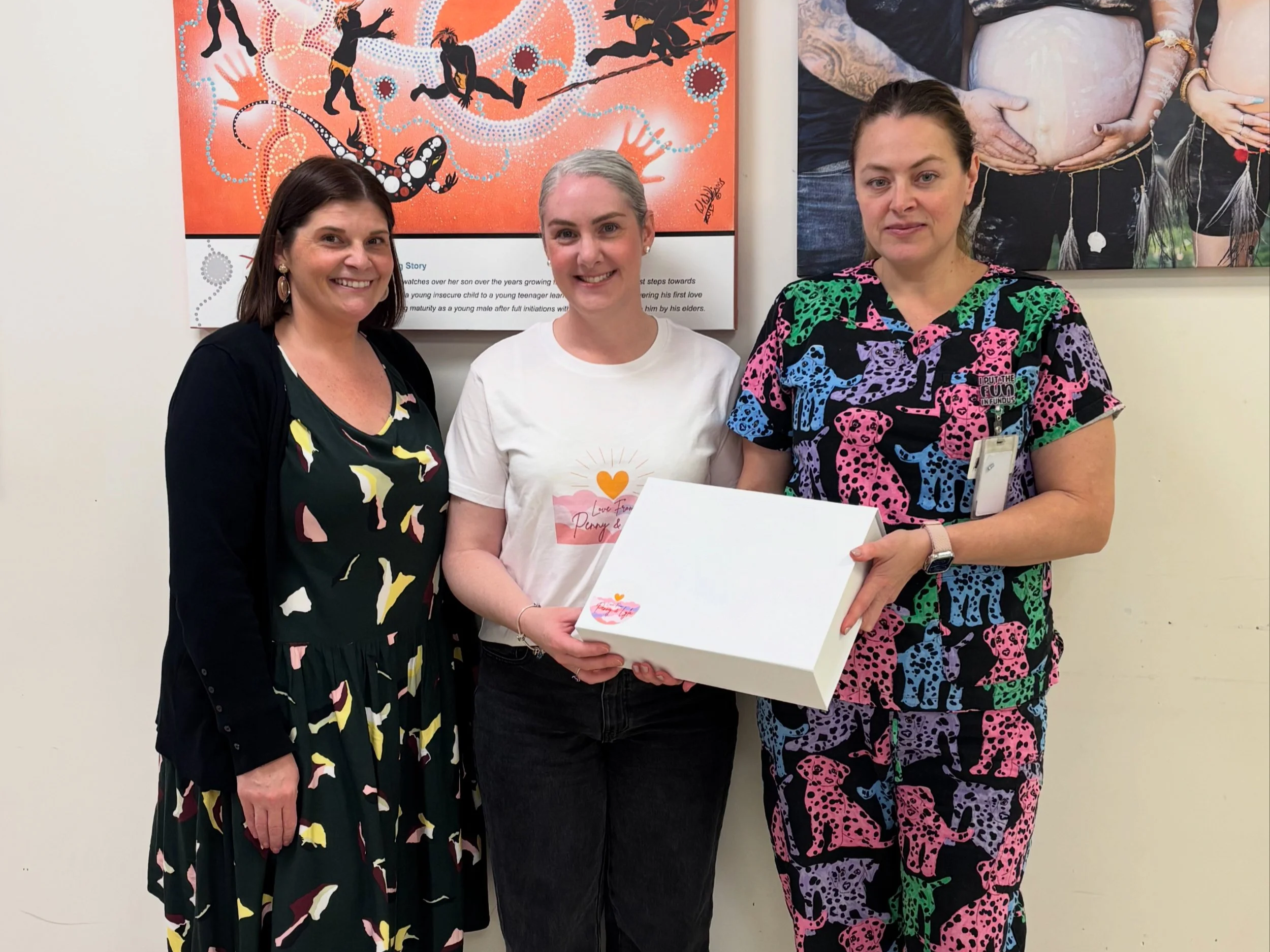
Awareness and Action
We are driven to raise awareness of the grief of baby loss at any stage, and break the stigma surrounding it. It happens to so many people, who suffer in silence. We partner with Canberra hospitals and clinics to improve support for bereaved families. By supporting and educating frontline carers, we help them offer more compassionate, appropriate care and teach what helps, from loss parents’ perspectives.
Boxes and Bags Donated
99 Care Boxes
•
79 Care Bags
•
99 Care Boxes • 79 Care Bags •

Every year in Australia, thousands of families lose a baby — to miscarriage, stillbirth, or a devastating medical diagnosis. These losses are common. The grief is real. And yet, for most of these families, the official record of what happened to them simply doesn't exist.
Here's the part that should make you angry: Australia has no national data collection system for miscarriage. There is no official register, no central record, no consistent count. Losses are scattered across GPs, hospitals and local health districts, with nobody joining the dots. That means there is no official figure for how many babies are lost to miscarriage right here in the ACT — not last year, not ever. Additionally, TFMR (termination for medical reasons) is not recorded separately in national statistics. Even stillbirth data varies significantly between jurisdictions and collection methods.
When loss isn't counted, it isn't funded, it isn't prioritised in policy — and the care given to grieving families reflects that.
This is the problem Love From Penny & Lyla exists to address.
In the ACT, 328 perinatal deaths were recorded between 2016 and 2020 — around 65 per year. This does not include miscarriages.
The Numbers We Don’t Talk About
Miscarriage
Miscarriage is the most common form of pregnancy loss, occurring in at least 15% of confirmed pregnancies — and estimated closer to 1 in 4 when losses before a pregnancy is confirmed are included. Across Australia, that equates to an estimated 285 miscarriages every single day.
There is no official ACT miscarriage figure — because no one collects it. Based on national rates applied to the ACT's approximately 6,000 births per year, we estimate between 1,000 and 2,000 miscarriages occur in the ACT annually. That is an estimate, not a recorded fact. And that is exactly the problem.
Please note: this ACT figure is a calculated estimate based on national rates (Miscarriage Australia) applied to ACT birth numbers (ACT Health). It is not an official statistic — because official ACT miscarriage statistics do not exist.
Sources: Miscarriage Australia; ACT Health, Perinatal Mortality in the ACT 2016–2020; SBS News, reporting on Pink Elephants Support Network.
Termination for Medical Reasons (TFMR)
TFMR is when a wanted pregnancy is ended due to a serious fetal diagnosis, chromosomal or genetic condition, or a risk to the life or health of the mother. It is estimated to affect 0.05–1% of all pregnancies in Australia — roughly 3,000 families each year. When a major congenital abnormality is detected, between 70–95% of those pregnancies end in TFMR.
TFMR is one of the most misunderstood and least supported forms of pregnancy and baby loss. Families often face stigma, guilt, and a healthcare system that doesn't always recognise their grief as grief. In Australia, TFMR is not recorded as a separate category in national statistics — when it occurs after 20 weeks, it is absorbed into broader stillbirth figures. There is no national TFMR register, and no ACT-specific figure exists.
These families grieve. They deserve support. And they deserve to be counted.
Sources: Marie Claire Australia, What Is TFMR, April 2026; Pink Elephants Support Network, Understanding TFMR; PMC, Stigma, Social Support and Decision Satisfaction in TFMR, 2023; AIHW, Preliminary Perinatal Deaths 2023.
Stillbirth
Stillbirth is the death of a baby at or after 20 weeks of pregnancy, or with a birthweight of at least 400 grams. In 2023, Australia's national stillbirth rate reached 8.7 deaths per 1,000 births — the highest recorded in over twenty years. On an average day in Australia, six babies are stillborn and two more die within 28 days of birth. The ACT has incomplete data on stillbirths from 20 weeks onwards.
At 6,000 births per year in the ACT, and applying the national rate of 8.7 per 1,000, that's approximately 52 stillbirths in the ACT each year. These are Canberra families, every year, leaving hospital with empty arms.
In the ACT, the rate of late-gestation stillbirth (after 28 weeks) was 3.3 deaths per 1,000 births over the 2016–2020 reporting period — higher than the national benchmark of 2.4 per 1,000.
Sources: AIHW, Preliminary Perinatal Deaths 2023; AIHW Stillbirths and Neonatal Deaths Dashboard 2023; ACT Health, Perinatal Mortality in the ACT 2016–2020; UNSW Embryology, Australian Perinatal Statistics.
Neonatal Death
A neonatal death is the death of a baby born alive who dies within 28 days of birth. Nationally, the neonatal death rate sits at 2.4 deaths per 1,000 live births.
Based on the national proportion, it is estimated that approximately 16–17 neonatal deaths occur in the ACT each year. This is a calculated estimate, not a separately published figure — because, again, the data doesn't exist in that form.
For many families, neonatal death follows days or weeks in a neonatal intensive care unit. That time is precious and traumatic in equal measure — and it requires a very specific kind of support that the system doesn't always provide.
Sources: AIHW Stillbirths and Neonatal Deaths Dashboard 2023; Red Nose Australia Facts and Figures (citing AIHW 2021); ACT Health, Perinatal Mortality in the ACT 2016–2020; ABS Deaths Australia 2024.
1,000 - 2,000
Estimated miscarriages in the ACT per year
52
Estimated stillbirths in the ACT per year (2016 - 2020)
Unknown
Number of TFMR in the ACT per year
16-17
Estimated neonatal deaths in the ACT per year (2016 - 2020)
The Impact on Bereaved Parents
Pregnancy and infant loss is not just a physical event. The research on what happens next is unambiguous: up to 60% of bereaved parents develop symptoms of PTSD, depression, or anxiety. Bereaved mothers are four times more likely to experience depression and seven times more likely to develop PTSD than mothers who haven't experienced loss. In Australian research, 75% of bereaved parents had PTSD scores indicating a need for mental health support, and 43% met the criteria for complicated grief.
These are not rare outcomes — they are the norm. And research shows clearly that the quality of care parents receive in hospital directly shapes whether those outcomes improve or worsen. The way we treat people on the worst day of their lives is not a nicety. It is a clinical intervention.
Sources: MDPI, The Trauma of Perinatal Loss, 2022; Policy Center for Maternal Mental Health (Gold, 2016); Stillbirth CRE eLearning, Australian Bereavement Services Research; PMC, Bereavement Care Guidelines Scoping Review, 2024.
What Love From Penny & Lyla Does About It
Against a backdrop of thousands of losses each year, no central data, and inconsistent hospital care, Love From Penny & Lyla has been quietly building something better — one care box at a time.
Since founding in February 2024, we have delivered 99 care boxes and 79 care bags — 178 acts of care — directly to bereaved families across the Canberra region, in partnership with 4 hospitals and 1 clinic. Every box, every bag, is chosen deliberately by people who have lived this themselves. Every one of our volunteers is a bereaved parent.
We can't fix the data gap overnight. But we can make sure that every parent the system doesn't fully see is still met with dignity, compassion, and something tangible that says: your baby mattered, and so do you.
As an estimate (thanks to limited recorded data), Love From Penny & Lyla has supported approximately 4.5% of parents who’ve suffered a perinatal loss or miscarriage in the past two and a half years. We need your help.
Support Us.

All donations go towards providing carefully curated care boxes and bags to Canberra area hospitals and clinics.
Follow our Journey.